At St. Mary’s, Religious Education is an integral part of our school life, provided to every pupil and adapted to suit the individual needs and abilities of each child. Our class teachers deliver Religious Education through a variety of engaging learning activities, real-life experiences, and moments of prayer and worship. This follows the guidance of the Come and See curriculum.

At St. Mary’s, children are encouraged to take responsibility for their actions and relationships, fostering a sense of care for themselves, others, and the environment. The school works in close partnership with our local parish and diocese to support individual and community efforts. Pupils also have opportunities to learn about and respond to the needs of the wider human family through charitable initiatives.

By helping children understand how beliefs shape lives, Religious Education at St. Mary’s promotes mutual respect and encourages cooperation between Christianity and other faiths.

RE is taught across the whole school following the scheme ‘Lighting The Path’. ‘This scheme helps children along their individual faith journeys and develop their religious literacy.

  • Autumn 1 – Branch 1 – Creation & Covenant
  • Autumn 2 – Branch 2 – Prophecy & Promise
  • Spring 1 – Branch 3 – Galilee to Jerusalem
  • Spring 2 – Branch 4 – Desert to Garden
  • Summer 1 – Branch 5 – To The Ends of The Earth
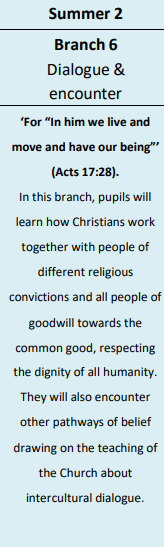
  • Summer 2 – Branch 6 – Dialogue to Encounter


Our RE subject leader is Mrs C Ruane.

The Liturgical Year begins on the First Sunday of Advent and runs through to the Solemnity of Christ the King.

Liturgical Cycles 

The Lectionary follows a Sunday and Weekday cycle. The Sunday Cycle is 3-yearly and denoted by letters A, B and C. Each year follows through one of the Gospels: A-Matthew, B – Mark, C – Luke. The Gospel of John is proclaimed on particular Sundays in each of the years. Week days in Ordinary Time follow a  2 year cycle numbered I and II. Year I is read in odd numbered years: year II is read in even ones.

We follow the guidance from Salford Diocese for the Liturgical Year, please follow the link Salford Diocese Liturgical Year Calendar 2025 2026


Liturgical Seasons

Advent

From evening prayer of the Sunday falling on or closest to the 30th November – The First Sunday of Advent – and ends before evening prayer of Christmas on the 24th December.

There are 4 Sundays of Advent.  They represent Hope, Love, Joy and Peace. 

Christmas

Christmas is celebrated from the evening prayer on 24th December to the Baptism of the Lord, which is the Sunday after the Solemnity of the Epiphany.

Ordinary Time

From the Monday following the Baptism of the Lord to Shrove Tuesday.

Lent

From Ash Wednesday until the Mass of the Lord’s Supper on the evening of Holy Thursday. There are 6 Sundays of Lent. Holy week begins on the 6th Sunday of Lent.

Easter Triduum

Begins with the Evening Mass of the Lord’s Supper on Holy Thursday and concludes with Evening prayer on Eater Sunday.

Easter Season

The Easter season begins with a celebration of the Easter Vigil on Easter Sunday and concludes 50 days later with Pentecost Sunday.

Ordinary Time

From the Monday following Pentecost until the Saturday before the First Sunday of Advent.

Liturgical Colours

There are 4 principle liturgical colours –

  • Green is used in ordinary time.
  • White is used in the seasons of Easter and Christmas, also on celebrations of the Lord.
  • Red is used on Palm Sunday, the Lords Passion, Good Friday and Pentecost Sunday.
  • Violet is used in the seasons of Advent and Lent.
  • Rose(Pink) can be used on the third Sunday of Advent – Gaudete Sunday – and the fourth Sunday of Lent – Laetare Sunday.

Multi Faith Work

As a Catholic School our primary focus is teaching the Roman Catholic faith. As such our curriculum includes teaching major world religions – such as Judaism, Islam, Hinduism, and Sikhism – to promote respect, understanding, and “love for one’s neighbour,” particularly in diverse communities.

Key aspects of teaching other faiths in St Mary’s include:
  • Contextual Understanding: Learning about other religions helps students understand the cultural and religious backgrounds of their peers.
  • Curriculum Integration: Studies of other faiths are integrated into the Religious Education (RE) curriculum to build a “community of hospitality”.
  • Respect and Dialogue: Education on other faiths is seen as a way to foster respect, dialogue, and better understanding of the global community.
  • Balanced Approach: While rooted in Catholic tradition, the goal is to make pupils religiously literate and able to engage with different beliefs.

In Summer Term 2 the whole school covers branch 6 within the lighting the path scheme (Dialogue & Encounter, see below)

As well as teaching other faiths specifically in Branch 6 ‘Dialogue and Encounter’, we also learn about other faiths throughout the year to link in with when they celebrate major religious festivals.We always focus on what we have in common with other faiths and their celebrations.